The exploration of Les Espaces Acoustiques proposed in this article highlights the links between a number of sound paradigms. The musical language of the cycle, which Grisey sums up as a call to “no longer compose with notes, but with sounds”, should not be interpreted as the radical exclusion of the sound paradigm that we have defined as simple, that is, of notes. The condition imposed by the instrumental writing and the mediation of models that are external to it, whose very principle is asserted by the composer, only partly explain this coexistence; in the 20th century repertoire, one can find examples of experimental compositional approaches that are more clearly removed from the influence of these historical paradigms, such as the sound-mass works of Xenakis or Penderecki from the 1950s and 1960s, the micropolyphonic works of Ligeti or the pre-spectral works of James Tenney. In Les Espaces Acoustiques, melodic, polyphonic and harmonic paradigms are explicitly used.
This is the case with the melody which, with Prologue, opens the cycle by assuming the primary character of a fundamental monodic gestalt. Admittedly, the melodic paradigm – as understood in its traditional sense – interacts with the spectral and neumatic frames of reference, but these are first and foremost formal schemes for organising pitches and not factors of sound complexity established on a perceptual level. They only become effective in the latter respect gradually over the course of the work, through the application of a concrete paradigm (enrichment of timbres) and a disjunctive paradigm (the intervals widen, making the perception of pitches more relative).
The polyphonic paradigm appears on several occasions, in a similar ambivalence, which is to say as the starting point or the end point of a sound complexity, according to an antagonism that articulates the segregation and coalescence of the constituent parts. The factors at work here are the density of the superimposition of the strata, but also the disaggregation of the lines themselves, again through the effect of a disjunctive principle: the widening of the intervals beyond the classic thresholds of contiguity undermines the boundaries of the tessitura and mixes the voices to the point of making them perceptually indistinct. Although the scale of registers is more extensive here, this principle can be compared to Ligeti's micropolyphonies, since in both cases the polyphony is saturated by the extreme intermingling of the melodic sequences.
Of all the simple sound paradigms, the harmonic paradigm is the one that Grisey seems to avoid most directly: there are few unambiguously perceptible chords in Les Espaces Acoustiques, and almost everything that comes close to them already falls under the ambiguous concept of the timbre-chord. This is not surprising, insofar as harmony is the central axis through which the composer intends to guide his musical style towards a timbral level; it is the very locus of liminality, so that the chord is almost always envisaged as being at the frontier of an additive paradigm, the foundation of the spectral conception that underlies the entire cycle. From the chord, understood as an extension of its traditional meaning, to instrumental synthesis, we have been able to distinguish five types of timbre-harmony, as presented in the following summary table (Figure 3).
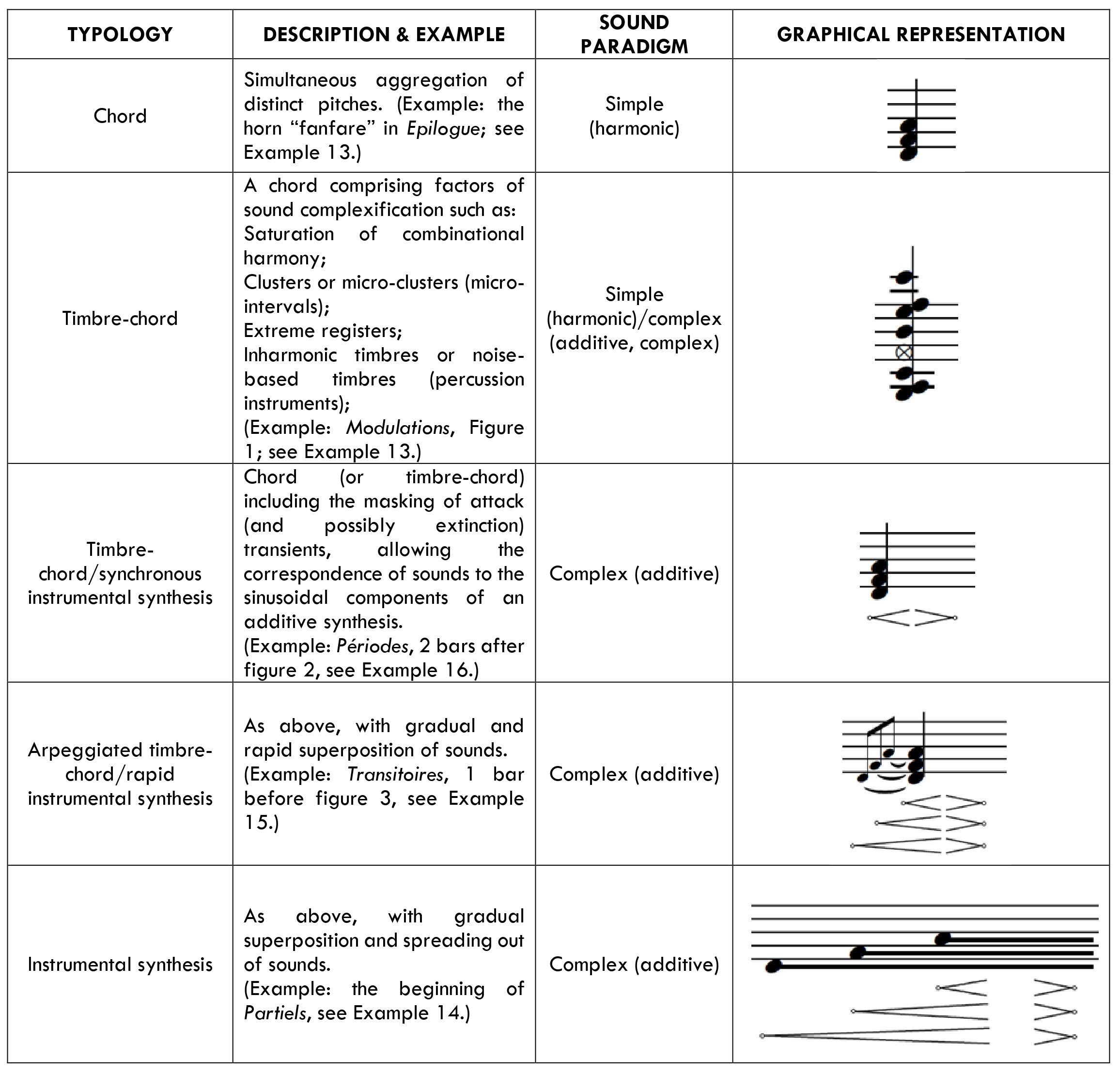
Figure 3. Typology of timbre-harmonies in Les Espaces Acoustiques.
We observed in Partiels that while the instrumental synthesis, as conceptualised by Grisey, represents the most developed organisation of the additive paradigm, it does not necessarily provide the strongest fusional efficiency. In principle, the progressive spreading of sounds reinforces the masking of attacks, but, on the other hand, its temporal unfolding works against a unified perception of the components of the simulated spectrum. In practice, the composer counters his own technique by staying at the extreme limit of conventional durations and by explicitly counteracting the masking of certain attacks. This apparent contradiction is explained by the didactic nature of Grisey's purpose, which is based on the interaction between synthetic and analytical intentions: the spectrum is to be heard alternately – and as far as possible, at the same time – as a result and as a process.
Such a duality is found most notably in the implementation of an interferential paradigm, as shown by comparing the treatment of the resultant sounds in Périodes and in Partiels. We have seen that only the first case is truly linked to such a paradigm, whereas the second is a simulation that aims to explore the sound phenomenon in greater depth than its actual onset would allow; thus, in Partiels, the resultant sounds constitute a formal frame of reference (they determine the material in abstracto, just like the spectrum in Prologue) and a complex phenomenal model suggested by analogy by means of essentially simple sound paradigms: a harmonic paradigm (aggregation of generative and differential sounds) including elements of an additive paradigm (such as the swells producing the impression of a natural generation of sounds) and a percussive rhythmic paradigm (for the simulation of beats).
Unlike the additive and interferential paradigms, to which the notions of timbral harmony and resultant sounds correspond, the granular and concrete paradigms are not subject to their own poietic intention in Les Espaces Acoustiques. They only appear in a subordinate relationship to other sound paradigms. The granular paradigm can be understood as the product of a polyphonic saturation, as we have seen above, but without being driven beyond the threshold of the coalescence of sounds that a more radical compression of durations would allow. On the other hand, in the case of Épilogue, it maintains a link with harmonic and additive paradigms: the massive aggregate resulting from the E1 spectrum, maintained as a virtual structure throughout the piece, is realised by clouds of notes, whose textural behaviour can be compared to the arpeggiated flux of conventional harmony, with the exception that the cumulative vertical and horizontal complexity produces here – especially at the beginning – is a fusional effect achieved through the saturation of perceptual thresholds.
The concrete paradigm is essentially subordinated to the additive paradigm as soon as it seeks a sound model that is not harmonic: the incorporation of an inharmonic or noise-based instrumental timbre adds a sound complexity to the chords or to the instrumental synthesis that favours the fusion of the components and helps to distinguish spectral aggregates from atonal aggregates. If this added complexity can be considered quantitative and mainly empirical in the case of percussive sounds and purely timbral effects (such as sul ponticello, flatterzunge, extreme vibrato, etc.), it relates more precisely to the organisation of pitches in the case of multiphonic sounds. The only notable implementation of the concrete paradigm freed from the additive paradigm is found in Prologue, where we have observed that the monodic setting forces the process of spectral complexification to rely on the viola's performance techniques.
The following table provides a summary of simple and complex sound paradigms, to which we add some of the examples mentioned above (Figure 4). In the first category, we add to the three main paradigms based on the structuring function of pitch, three paradigms that articulate sounds of ambiguous, relative or indeterminate pitch, but which can still be classified as simple in that their elementary constituents (discretised sounds or individual sound inflections) retain their perceptual identity and their organisation is not intended to produce a complex phenomenon: the disjunctive, neumatic and rhythmic percussive principles.
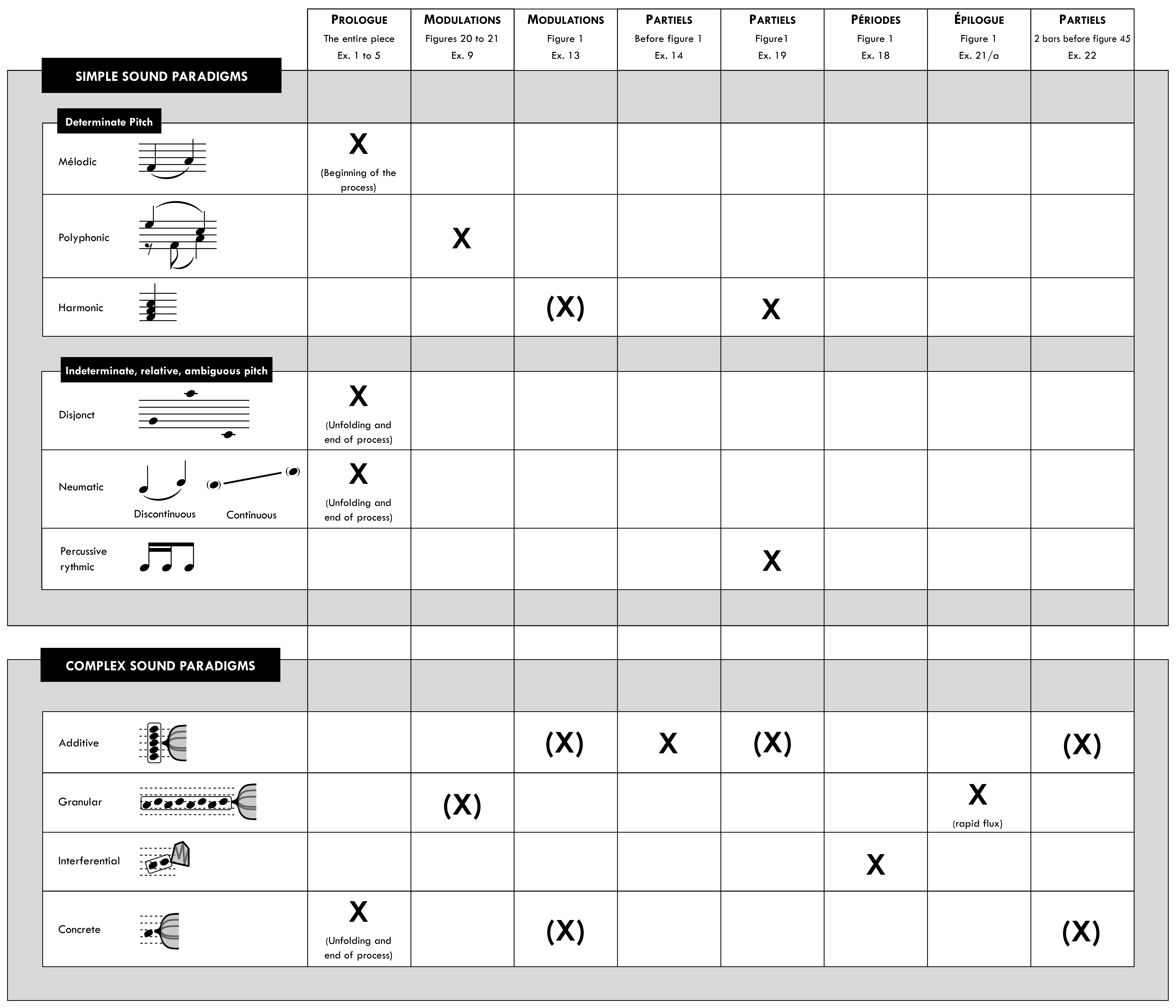
Figure 4. Summary table of sound paradigms with examples from Les Espaces Acoustiques. (N.B. The crosses in brackets indicate a partial or ambivalent relationship with the sound paradigm in question.)
The wide range of occurrence, significance and articulation of simple and complex sound paradigms in Les Espaces Acoustiques illuminates the vision of a “differential, liminal and transitory” music. No paradigm is excluded from the compositional approach, and none is developed for its own sake; Grisey's spectralism, despite its formative achievements, is less concerned with pure acoustic complexity or perceptual illusionism than with the very dynamics of the interaction of the sensory dimension of his approach to sound. An overly literal or fragmentary reading of the composer’s poietic intentions should not blind us to the fundamentally mediating nature of his aesthetic conception.
The first and most naive mistake might be to think of spectralism as a simple and accurate reproduction of the complex sound phenomena processed by electronic synthesis. This misconception is cleared up by the composer himself, albeit ambiguously, when he states that
Despite all the care that can be taken with the instrumental writing, it is never possible to perfectly simulate a continuous transition from one timbre to another. [...] The instrument resists continuity as much as it resists fusion, but this dialectical tension between the composer's intention and the resistance of the material is so rich in consequences that I often wonder if, in this case, the instrument is not preferable to synthetic sound precisely because of its limitations and imperfections [1].
The words “I often wonder if...”, which frame the formulation of what seems to be such a fundamental principle should be noted: liminality is embodied in Grisey's work primarily in the gap between the instrumental medium and the sound model. We have noted that complex sound paradigms can generally only be approached, but rarely fully realised, in instrumental composition. In this respect, the under-representation of the concrete paradigm in Les Espaces Acoustiques – or at least its auxiliary condition – does not seem accidental: it is the only one that can dispense with the mediation of a combination of sounds, or in other words, the only one that offers a possible direct productive relationship between intention and result.
But another – more subtle – error would be to think that the friction in question here lies only in the gap between the “composer’s intentions and the resistance of the material”, namely: that the mediation between the intended sound complexity (“the composer's intention”) and its impossible reproduction would be based solely on the intrinsically limiting condition of instrumental music, while within this predetermined field, the compositional act would consist in using all possible technical means to produce the closest possible simulation of the model, thus reinforcing the dialectical tension inherent in sound mimesis.
However, our study as a whole has revealed contradictions of a different order: the technical means Grisey uses are generally not focused on such unambiguous ends. They are themselves countered in their implementation, as is strikingly evident in everything in Partiels that opposes the full effectiveness of instrumental synthesis. There is a mediation within the mediation, so to speak, where the fundamental dialectical tension is placed at the centre. This refusal of immediacy typifies here an aesthetic that is expressed “between the interstices”, in which the differential, the liminal and the transitory refer not only to complex sound models, but to a dynamic of logical antagonisms deliberately maintained between these models and the instrumental resources, the compositional techniques and the poietic intentions. The complexity of Grisey's art therefore seems to stem from the constant limitation of his means.