Beyond the zones of ambivalence in which some of the examples observed so far (melodic glissandi, polyphonic textures and timbre-chords) are still based on traditional combinations and parameters, a shift takes place towards sound paradigms that can be described as complex in the sense given in the introduction to this article. The liminality that is an integral part of Grisey's approach stems from the way these paradigms are mediated via the instrumental writing, which can only partially reach the fusional levels of complex sound, but also from the constant interweaving of these paradigms with those mentioned above, articulated in various relationships of analogy and continuity. What allows us to define complex paradigms more clearly, however, is the effective ordering of all the parameters of the instrumental writing towards the perceptual neutralisation of pitch, at which point the musical material moves towards the level of timbre or its composition.
The neutralisation of pitch is realised by subverting (that is, by reducing or augmenting) the boundaries of timbral, harmonic and temporal densities which, in simple sound paradigms, ensure the perceptual identity of sound combinations. In concrete terms, this is carried out on three levels:
- Timbral: by “thinning” the sound, which causes a perceptual deindividuation that more easily lends itself to fusional combinations; by enriching the sound, which causes inharmoniousness, noise or instability;
- Harmonic: by simplifying the ratios, which favours fusional combinations; by making the ratios more complex, which leads to effects of interference or saturation;
- Temporal: by lengthening durations, which disrupts sequential continuity and encourages perceptual immersion; by shortening durations, which favours granular effects.
Figure 1 shows these three sound dimensions on a cubic space: in the centre, the small orange cube represents the average level ("0") of traditional densities in which simple sound paradigms are used; the large cube that surrounds it represents the densities that are subverted by reduction ("-") or by augmentation ("+") and through which complex sound paradigms are applied.
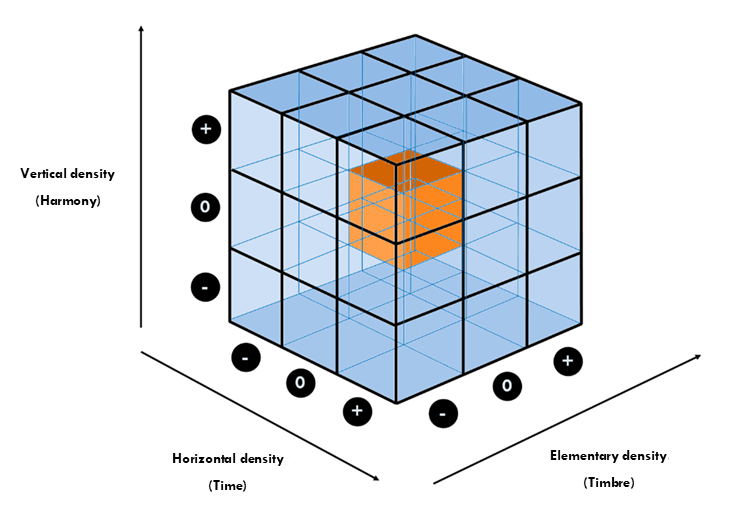
Figure 1. Representation of sound density dimensions in cubic form.
These extreme densities make it possible to reach or reproduce the microphonic level of sound complexity. We therefore suggest that the structures of the phenomena that occur at that level are comparable to the structures found in electroacoustic synthesis. From this, we can distinguish four complex sound paradigms: additive, interferential, granular and concrete. Their definitions will be given in the following pages.