2. Complex Sound Paradigms
We have seen that, in Les Espaces Acoustiques, the additive sound paradigm was to be considered in relation to a compositional concept called instrumental synthesis, though it is not to be conflated with it. In terms of the interferential paradigm, there is a similar ambivalence between this sound paradigm and the different ways in which it is implemented.
The interferential paradigm concerns pitches whose interplay gives rise to phenomena of disturbance or reinforcement of the initial frequencies, as well as to the generation of new frequencies, such as the so-called resultant tones, that is, tones corresponding to the difference and the sum of the two superimposed frequencies and which are perceptible in certain situations. Essentially, these phenomena derive from a principle of electroacoustics called modulation, which in the field of sound synthesis designates all the techniques that use the transformation of a signal by the action of another signal, the first being called the “carrier” and the second the “modulator” [1]. In actual instrumental composition, however, such precise operations are often not applicable because the components that make up the complex sounds cannot be controlled by the compositional process.
However, two non-empirical approaches allow them to be modelled by an instrumental poiesis of complex sound, which is what Grisey does. The first approach focuses on the limited part of the interference phenomena that can be implemented precisely, effectively and audibly, provided that all the textural elements that could compromise the listening experience are excluded: the aim is to generate and give voice to the emergence of a microphonic, infra-notational complexity. The second approach consists in simulating a modulatory phenomenon on the macro-phonic scale of instrumental writing: the sound effect resulting from an interference is not really produced, but calculated, transcribed and orchestrated. In the latter case, the phenomenon constitutes, so to speak, only a compositional model like any other, and does not presuppose the effectiveness of a truly interferential sound paradigm. An example, frequent in Grisey’s work and more broadly in spectral music, is found in the calculation of pitches through the virtualisation of a ring modulation: once calculated, the spectral model does not, in theory, call for any other treatment by the writing than if it had been derived from a sonogram or from the composer’s imagination.
We can get an idea of how these two approaches coexist by examining the modelling of the resultant tones in Périodes and then in Partiels. Resultant tones, we recall, are sounds corresponding to the difference and the sum of two superimposed frequencies, which are perceptible in certain situations. Discovered in the 18th century by Sorge and Tartini, and mentioned by Helmholtz in the following century, they remain largely beyond the reach of compositional treatment. However, when the differential sounds are below the audibility threshold, that is, below 20 Hz, they produce beats that can be perceived and, to a certain extent, controlled without any difficulty: this aspect of the phenomenon can therefore be included in a truly interferential compositional approach.
This is the approach taken by Grisey in Périodes (Example 19). The viola part uses scordatura tuning, a technique he borrowed from Giacinto Scelsi [2], where the notation is spread over several staves: the chord here is A-D-G-D, so that the fourth string, raised by one tone (from C to D), is an octave below the second string (Example 18). The instrument therefore has two strings being played in the same spectral field. The scordatura tuning opens up further spectral possibilities: the open second string and the octave harmonic of the retuned fourth string provide two perfectly stable Ds, allowing for combinations involving interference with the third string, as well as different resonances. Set against the violin, which is tuned in the usual way, a polyphony of interferences and a polyrhythm of beats is created. The number of beats is strictly defined (even if the indication allows for a slight margin of approximation) and makes it clear that it is the infra-notational level that dictates the adjustment of the notational level: the pitch results from the control of the beats, and not the other way around.
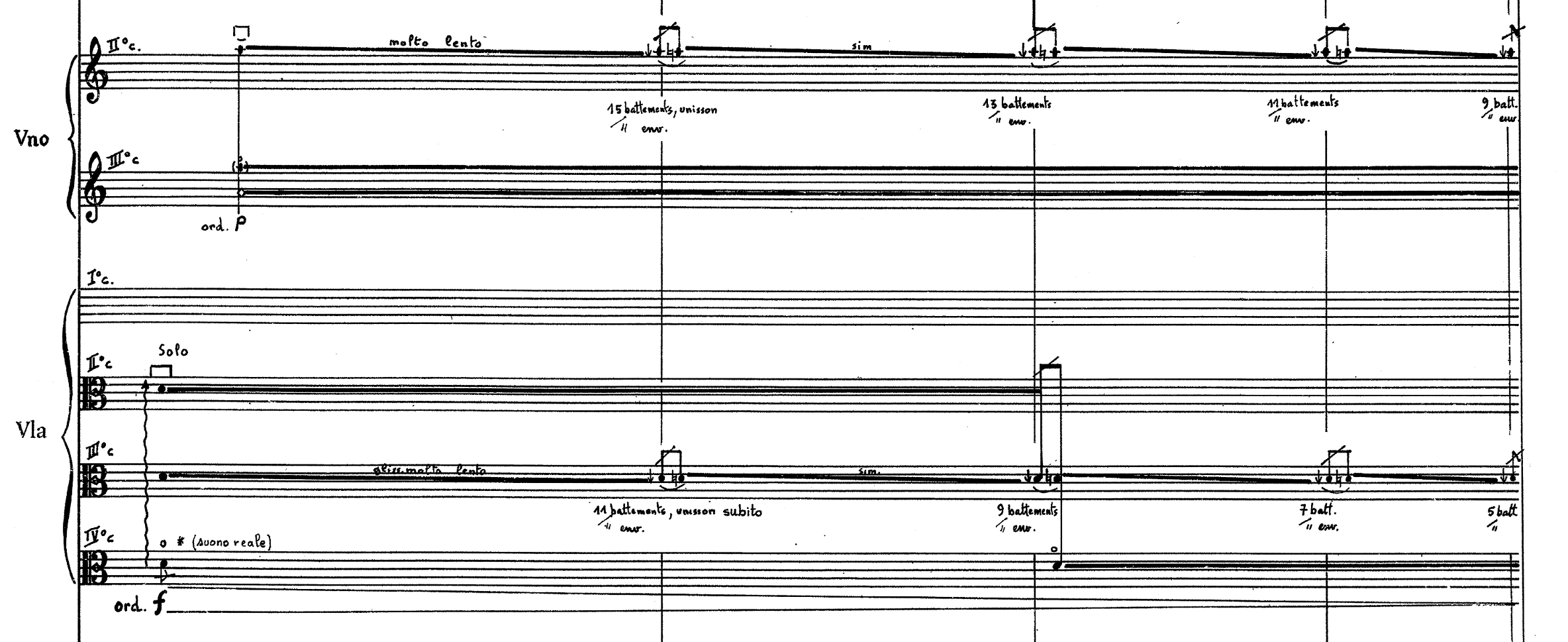
Example 19. Périodes, beginning.
(© Ricordi s.r.l., Milano.)
In the second part of Partiels, a simulatory approach is preferred (Example 20). As François Rose explains in his article on the techniques of writing spectral music (see the footnote below for a more detailed analysis of the work [3]), two generating sounds, C and D flat (in blue), produce two resultant tones. The first, resulting from the difference between these fundamentals, falls under the threshold of audibility, and thus gives rise to beats represented by the rhythm of the double bass (in red): 69.3 Hz − 65.4 Hz = 3.98 Hz, or approximately 11 quavers for 4 beats (crotchet = 88). But the fact that Grisey adopts a purely simulatory approach means that through calculation and the illusionary suggestion of the instrumental writing, he can give acoustic credibility to more complex phenomena, which would remain difficult to control and absolutely imperceptible if they were left to be heard as they are. The second sound is therefore a so-called second-order resultant sound, in other words, it is not the result of the interference of the fundamentals, but of the harmonics of the generating sounds. The D of the viola (also in red) is therefore the result of subtraction (4 × 69.3 Hz) − (2 × 65.4 Hz) = 146.38 Hz. Finally, the two pitches highlighted in green are harmonically linked to the generating sounds in relation to virtual “superfundamentals”: the cello’s G is the 3rd harmonic of a low C of which the horn’s C would be the 2nd harmonic; the double bass’ F sharp is the 2nd harmonic of a low F sharp of which the C sharp would be the 3rd harmonic.
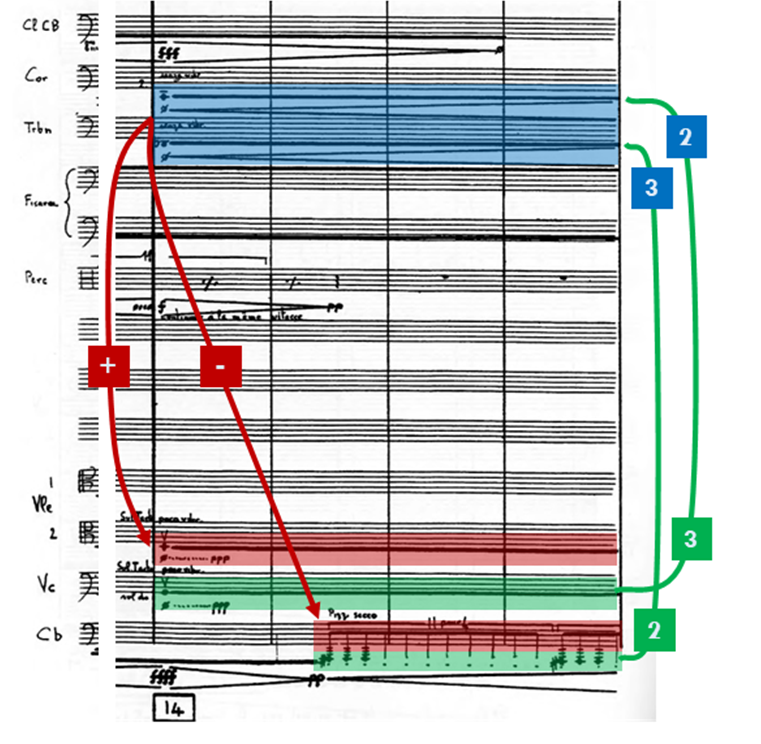
Example 20. Simulation of differential tones in Partiels.
(© Ricordi s.r.l., Milano.)
The resultant tones, whether real or simulated, constitute only a part of the interference effects used in Les Espaces acoustiques. There are many other occurrences that add to the spectral writing; they differ from the last two examples because their aim is not a specific frequency result, but a global effect of complex sound emergence. This is the case, in Périodes, when all the instruments focus on D, repeated emphatically by the trombone (Example 21). This pitch is played in an dissonant unison, which produces a thickness that cannot be notated or calculated in terms of frequency, and which could be described as a moving micro-cluster. The process, which again seems to have been borrowed from Scelsi, brings the interferential paradigm into play in a melodic-harmonic dimension through the overlapping of the trajectories of the glissandi.
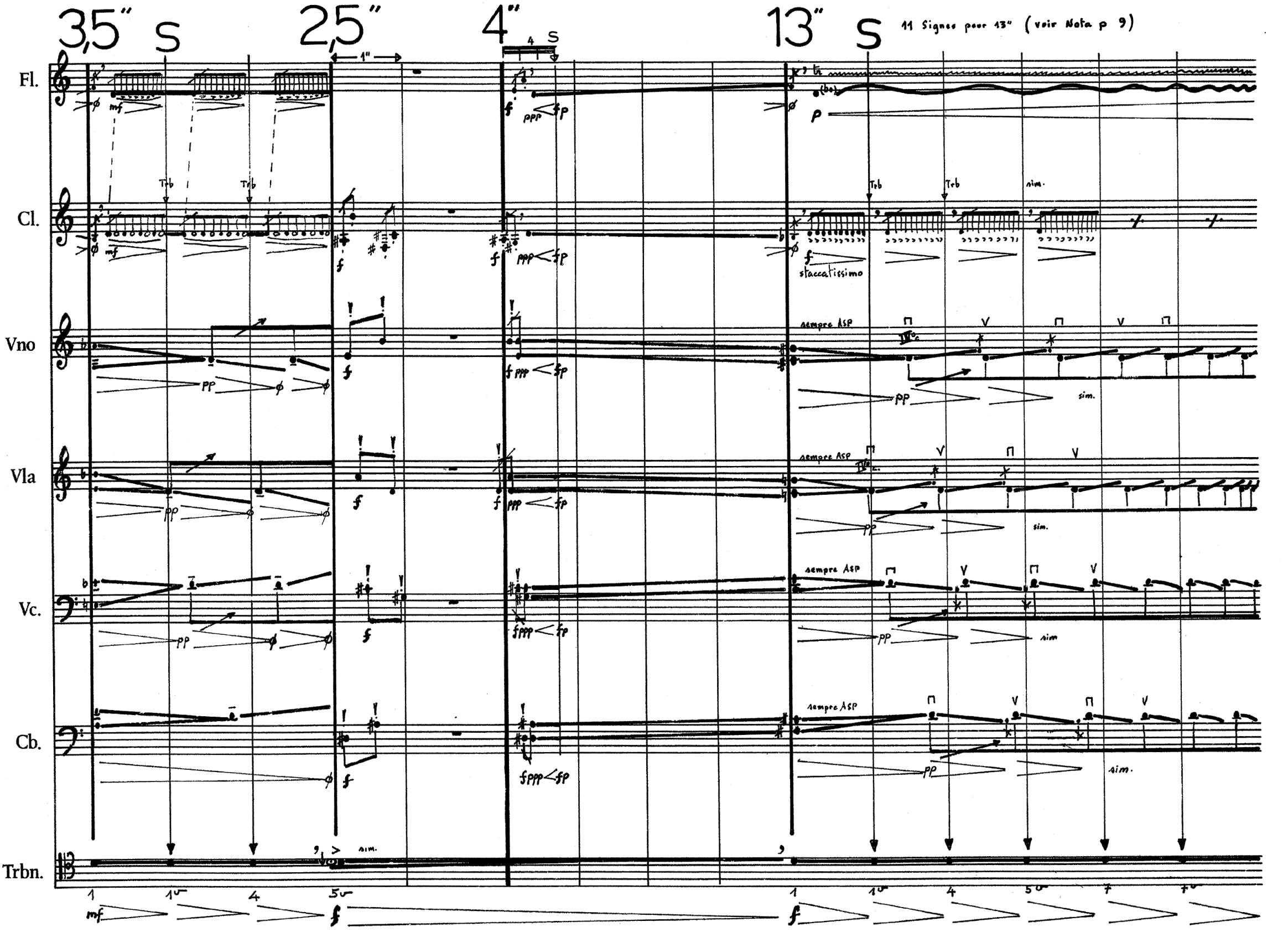
Example 21. Périodes, 3 bars after figure 4.
(© Ricordi s.r.l., Milano.)