1. Simple Sound Paradigms
In terms of sound paradigms, polyphony can be understood as a simultaneous combination of melodies, that is, sequences of distinct pitches. Within this broad category, a variety of degrees and ways of differentiating the relationships between voices can be distinguished. Organum and heterophony, for example, are less formalised paradigms than counterpoint, whose strict rules on the relationship between the voices are intended to ensure a maximum level of autonomy for them. Although the emancipation of tonality makes a comparable degree of formalisation impossible, several compositional parameters allow Grisey to articulate different levels of polyphonic delineation in this respect as well. This differentiation is explained by the fact that the sections that can be described as polyphonic are never clearly marked out, but always understood as the culmination or the starting point of another sound paradigm.
There are four polyphonic instances in the Les Espaces Acoustiques: in Périodes, figures 16 to 22; in Partiels, figures 23 to 28; in Modulations, figures 20 to 21, then 31 to 39. The first two cases are quite similar in terms of polyphonic delineation (Examples 6 and 7). The polyphony is achieved through the accumulation of strata and the widening of the overall range. Initially, the level of autonomy of the voices is very low, for four reasons:
- The timbres and dynamics are uniform, making them suitable for fusion (due to the nature of the instruments, but also due to the spectral thinning caused by the high register and the quiet dynamics [1]);
- Within each voice, the intervals are very disjunct, weakening the melodic paradigm (disjunctive paradigm);
- The sharing and mixing of registers intertwines the parts;
- Simultaneous points of convergence are avoided, following the interweaving between voices rather than counterpoint, which produces a hybridisation of a single melody rather than a superposition of melodies.
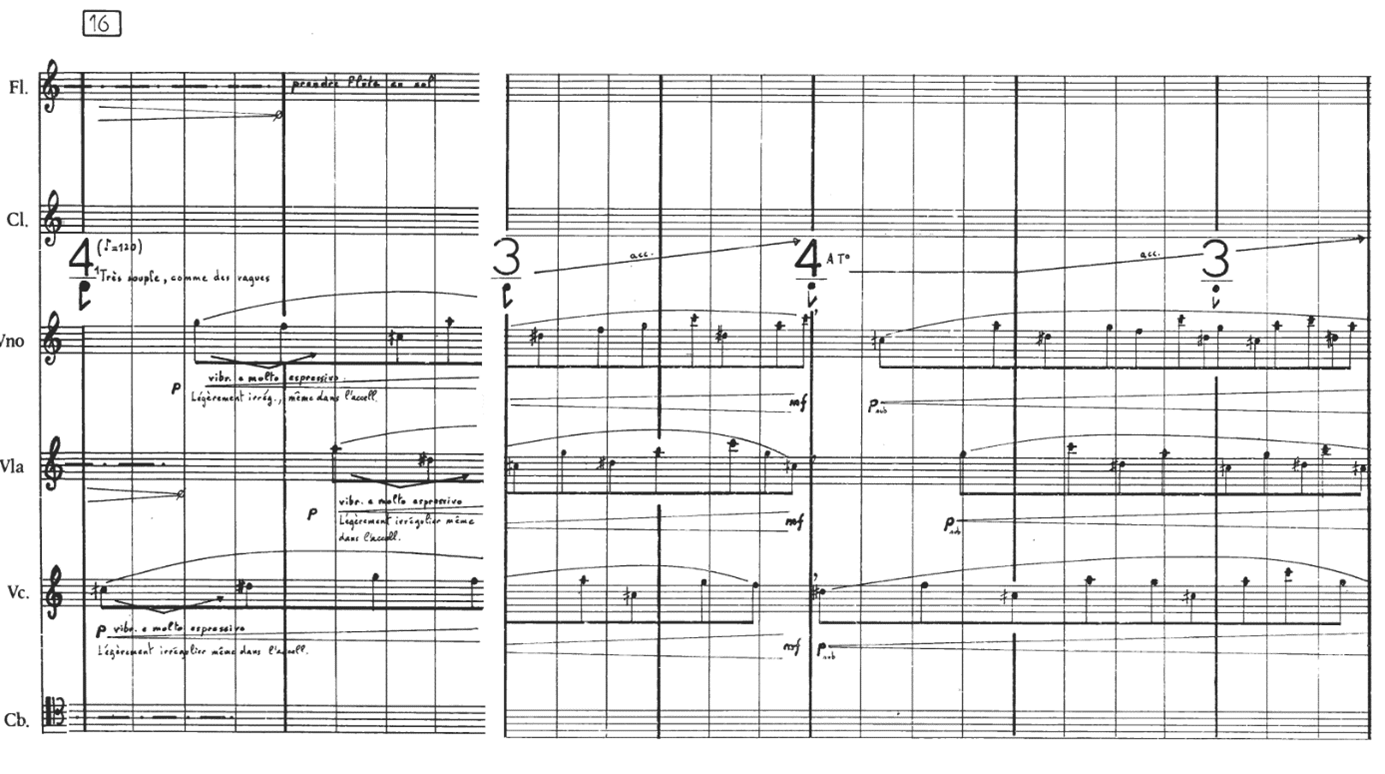
Example 6. Périodes, p. 3, figure 16.
(© Ricordi s.r.l., Milano.)
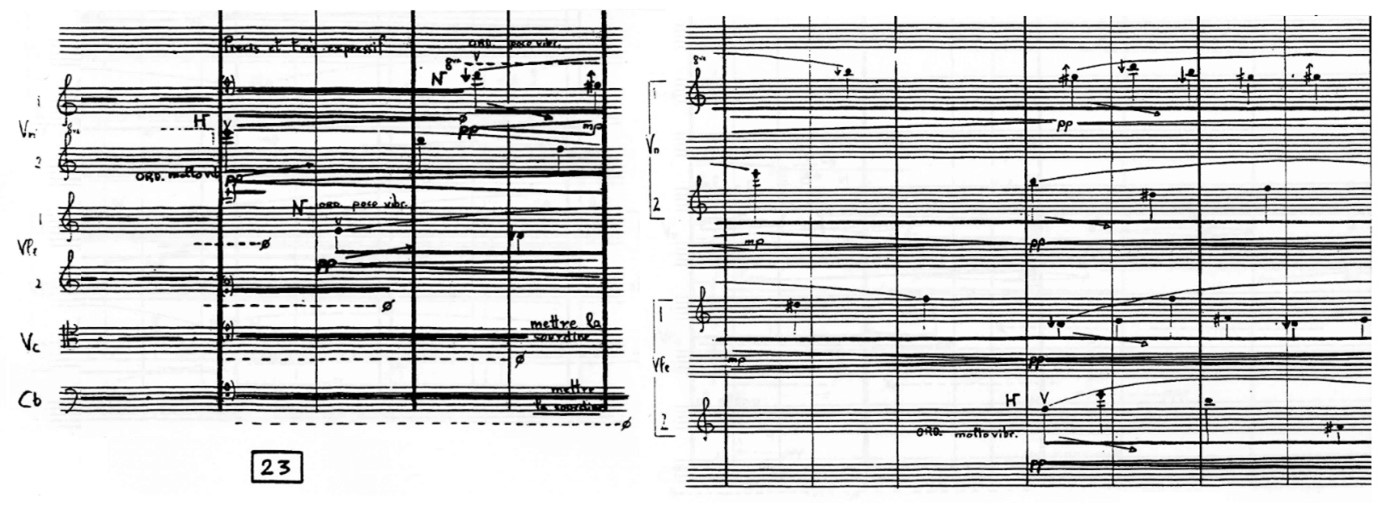
Example 7. Partiels, figure 23.
(© Ricordi s.r.l., Milano.)
In the second example, this effect is partly achieved by the pairing of instruments that are intended to be heard as one, as the composer specifies in the score. The different pairs, which share the same pitch range, alternate throughout the passage and should “emerge slightly from the polyphony”, as indicated by the markings borrowed from serial language, Hauptstimme (main voice) and Nebenstimme (secondary voice), which here distinguish the first pair (violin 2 and viola 2) from the other instruments. However, this indication alone does not change much in the overall indistinctness of the lines, which is due to the four factors given above – again two contradictory paradigms – and through which a hybrid between melody and polyphony is produced, very much in keeping with Grisey’s aim, acting here on two interconnected levels: the “meta-instrument” formed by two instruments, producing an initial melodic-polyphonic hybrid; the ensemble of these “meta-instruments” and the others, forming a second, more complex melodic-polyphonic hybrid.
The changes in the textural parameters lead, in both cases, to a gradual individuation of the voices, gradually bringing the sound paradigm closer to a more conventional polyphony, as the sole example in the Périodes movement will suffice to show (Example 8). The timbres are now distinct (especially the trombone, which is hardly suitable for fusion) and are made richer by the fff dynamics. Compared to the beginning of the passage, where the intervals remain equally disjunct in absolute terms, these differences diminish from a perceptual point of view as the extension of the overall range shifts the weight of the contrasts onto the differences in registers (low-mid-high); each part, or at least each group of parts, has a differentiated sound space. On the other hand, the increase in tempo favours melodic continuity within each part and the articulation of points of convergence or quasi-interaction between the voices (moving from diagonal layering to vertical superimposition), which are otherwise differentiated by distinct rhythmic values.
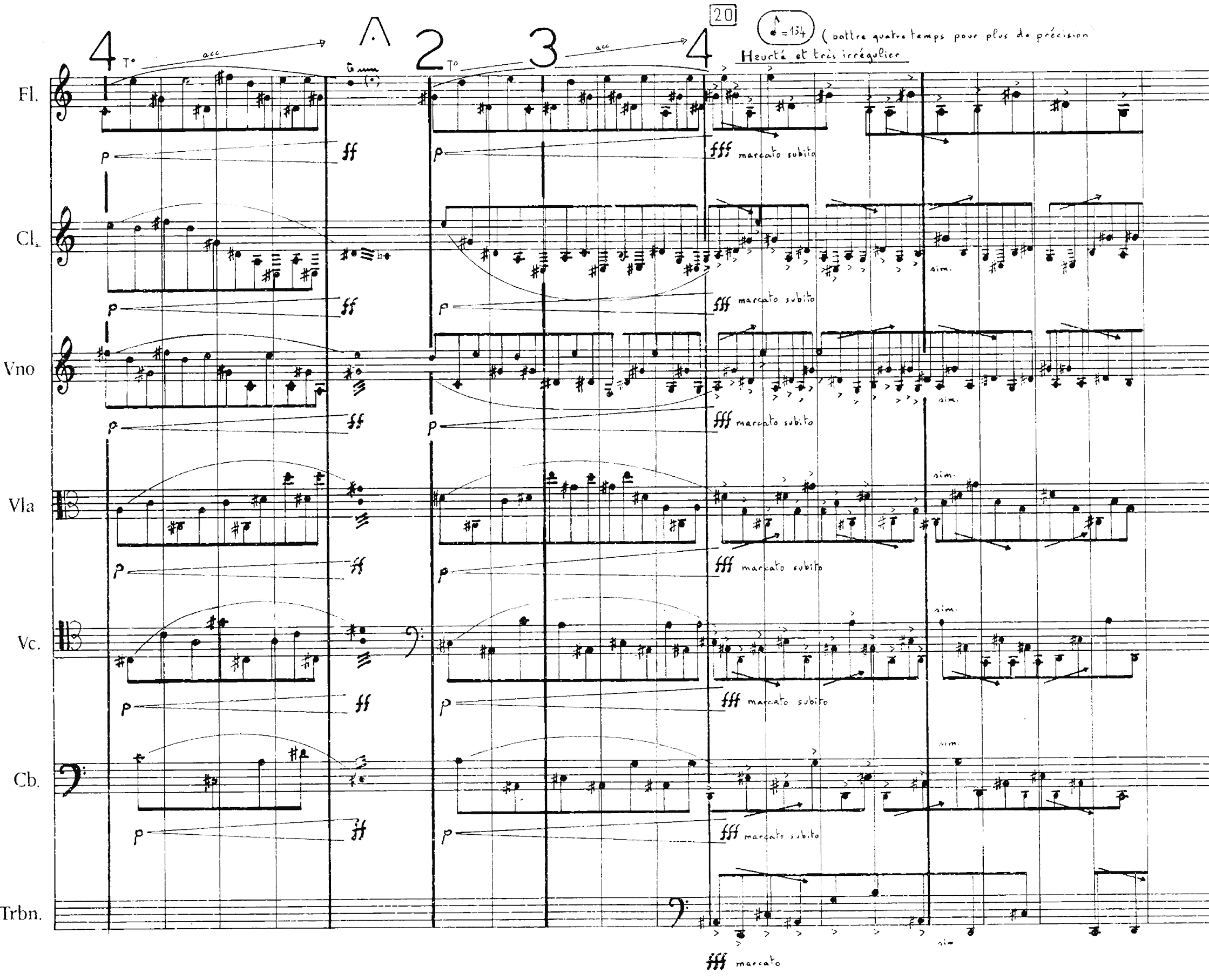
Example 8. Prologue, 4 bars before figure 20.
(© Ricordi s.r.l., Milano.)
The two polyphonic passages in Modulations, by contrast, are more melodically shaped from the outset owing to the use of conjunct intervals. The first of these passages (Example 9) is even more reminiscent of György Ligeti’s micropolyphonic textures than the others – in the sense that the clashes of the different voices, which are no less entangled than in Périodes and Partiels, this time allow more prominent pitches to emerge due to the adjacency of the intervals. As John MacKay explains in his study of the perception of granular textures, such levels of prominence can emerge from regular aggregations giving rise to rhythmic groupings, or from protrusive linearities (that is, as if extruded from the overall texture) giving rise to melodic groupings [2].
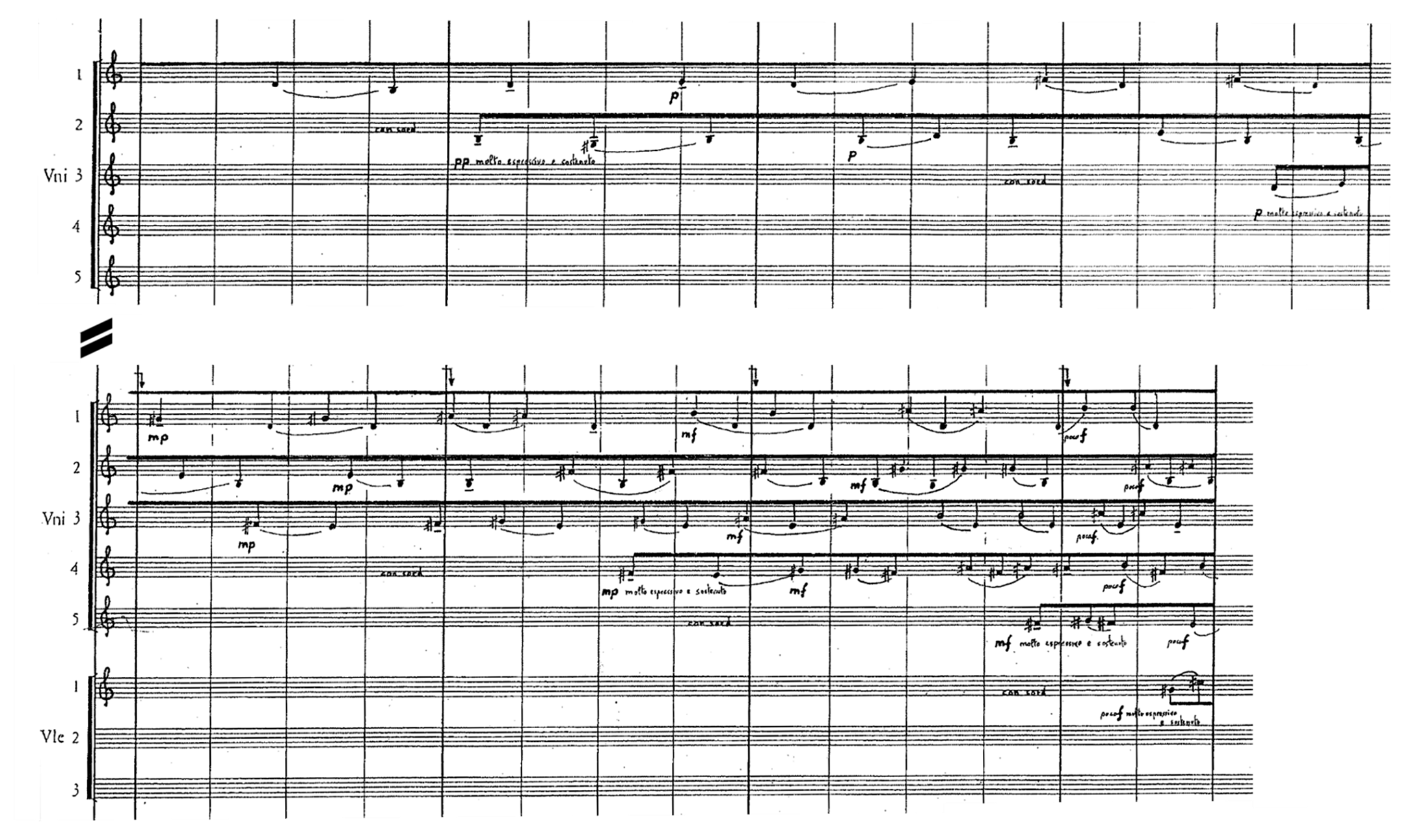
Example 9. Modulations, 5 bars after figure 19.
(© Ricordi s.r.l., Milano.)
The change in this texture happens, as before, via an accumulation of parts, a widening of the range and an increase in the degree of polyphonic perceptibility (Example 10). However, this does not come about from within the initial parts, which remain weakly individuated, but by the addition of a second group of parts that differs radically from the first via the use of plucked sounds (low strings, harp) and resonant sounds (celesta, vibraphone, marimba). Within this ensemble, the points that accumulate and contract are mixed together in the same manner as Ligeti; in other words, the two groups are once again made up using two superposed “meta-instruments”, so that the polyphony unfolds on two levels: one, internal, weakly determined, allowing for a heterophonic meshing; the other, external, enabling the clear articulation of two strata.
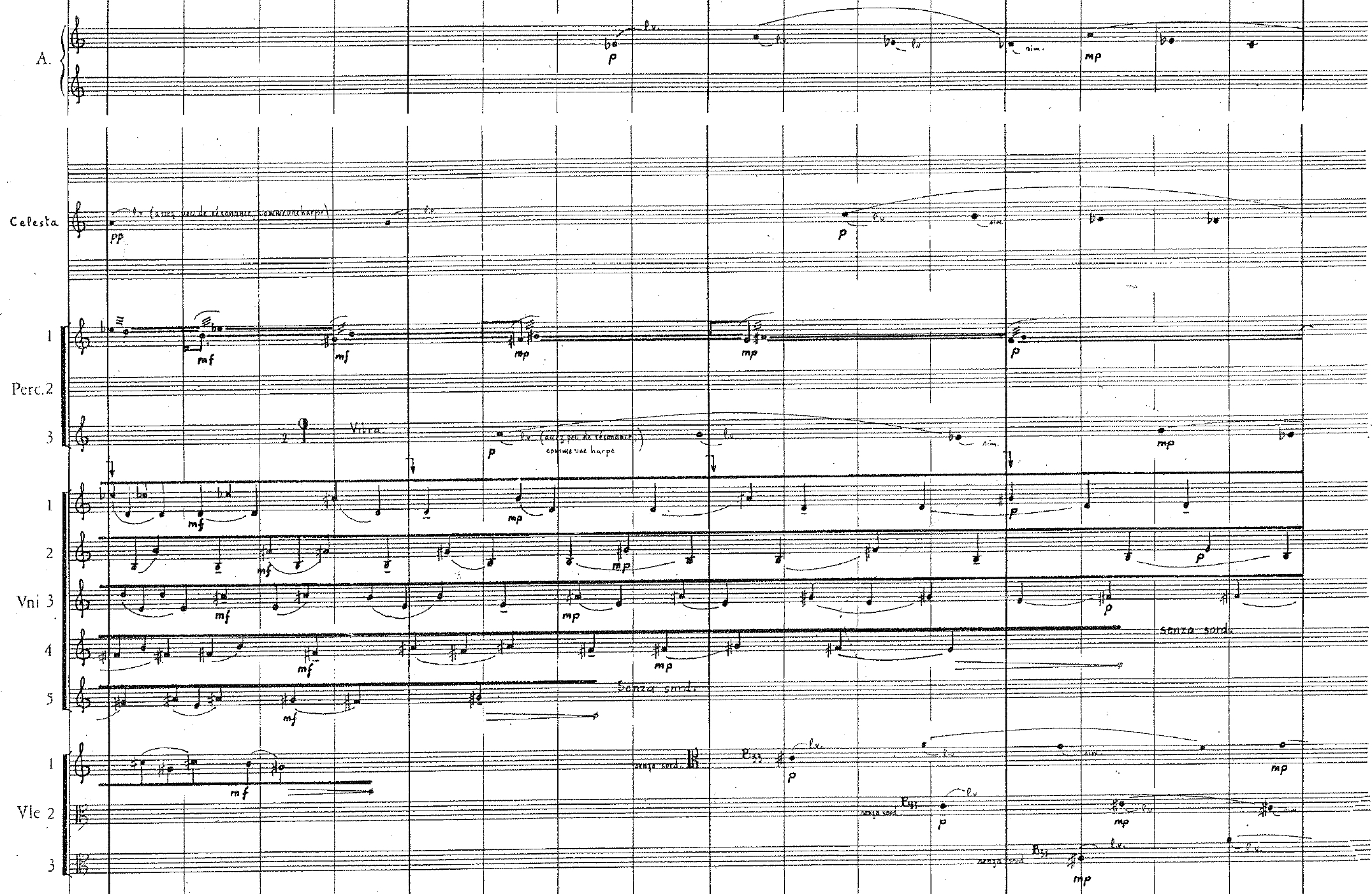
Example 10. Modulations, figure 20 (detail).
(© Ricordi s.r.l., Milano.)
This meta-instrumental grouping is found at an unequalled level of systemisation in the chord-blocks that appear later in Modulations. However, this is initiated by another remarkable polyphonic passage (figures 31 to 39, Example 11), whose aim is unique in Les Espaces Acoustiques. To make the subsequent process of “coagulation” more striking, Grisey starts here with the most conventionally polyphonic texture of the cycle. The score is divided into four instrumental groups made up of similar instrumentation. But these groups do not, at this stage, have the unifying function of meta-instruments, for the internal principle that governs them stems from the individuation of the lines: firstly, through the highly differentiated timbre, and secondly, and more importantly, through the rhythmic differentiation of the parts, which is closer to traditional counterpoint than the previous examples.
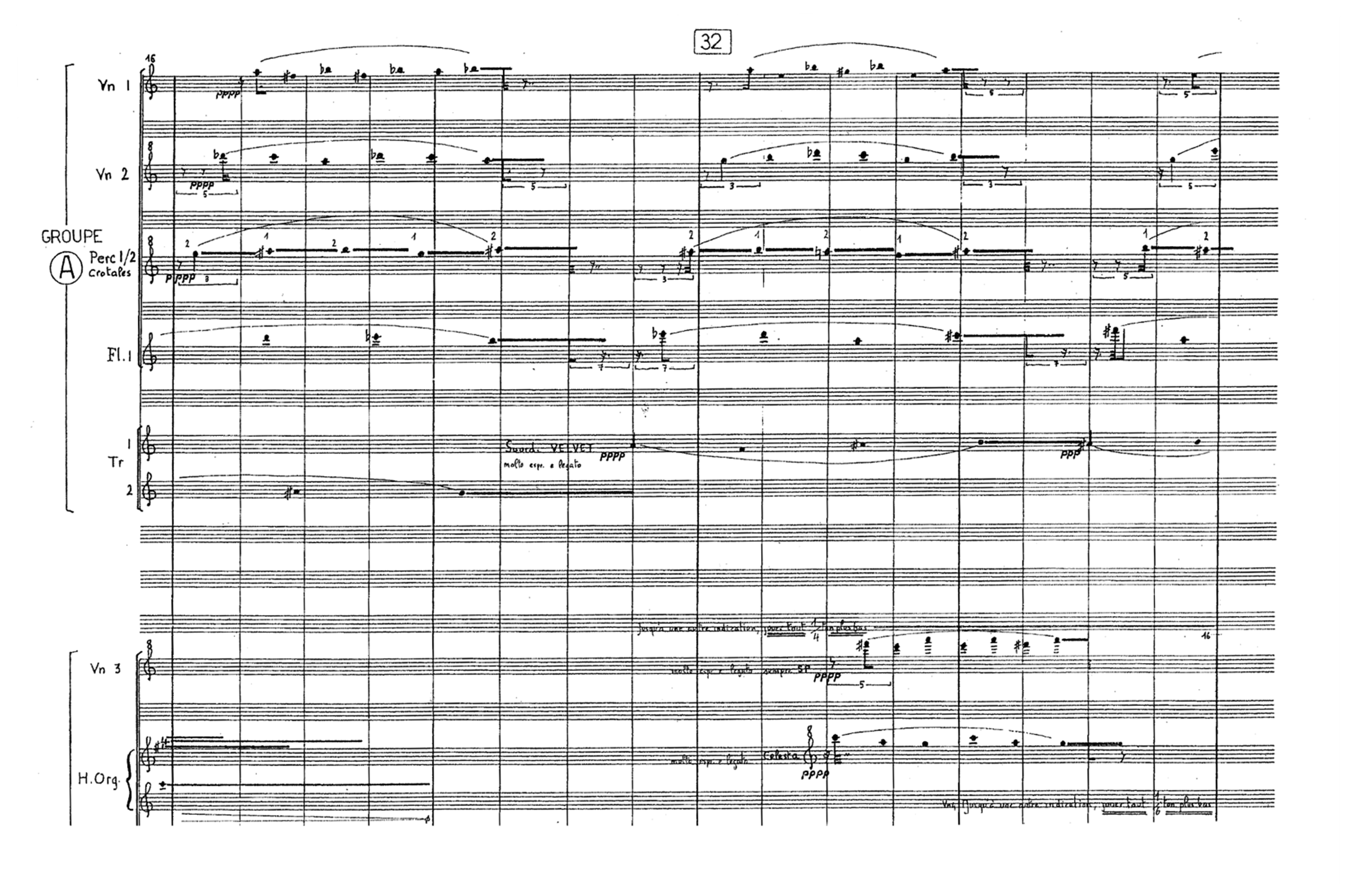
Example 11. Modulations, 8 bars before figure 32 (detail).
(© Ricordi s.r.l., Milano.)